AI & Automation
Why Your AI Automation Might Need a Rebuild Before It Ever Scales
Replit's CEO says AI agents will run companies. For operations leaders, the urgent question is whether your current automation can evolve—or will need replacing.
Your CRM now drafts follow-ups. Your accounting tool categorizes expenses. Your support desk suggests replies. Each works alone, and each promised to save hours.
Yet your team still spends mornings copying data between systems, chasing exceptions the tools can't handle, and explaining to leadership why the "automation" budget keeps growing while the coordination headaches don't stop.
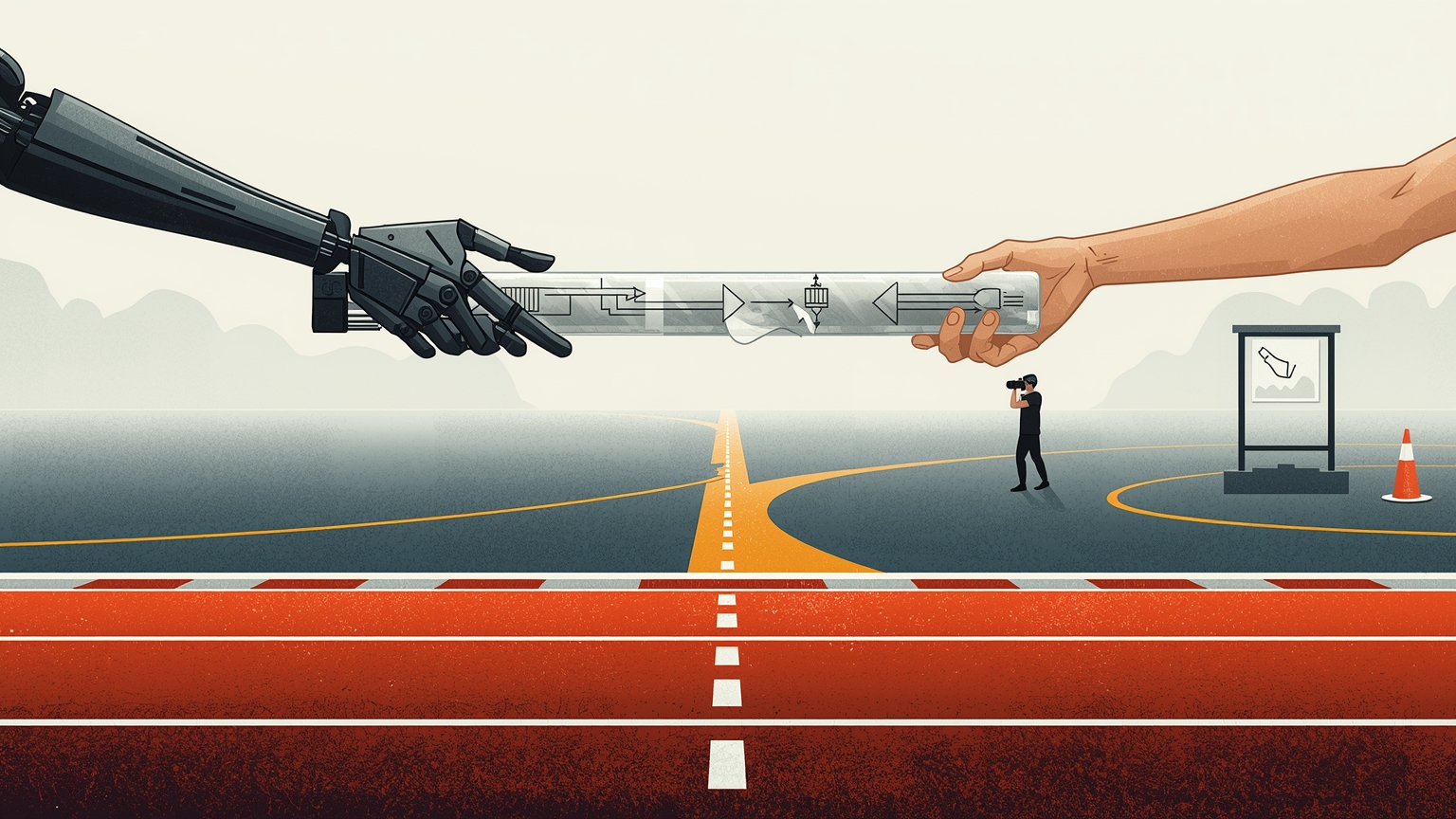
This is the gap between automating tasks and restructuring operations. Replit CEO Amjad Masad just named where the market is heading: the "self-driving company," where AI agents handle daily execution and humans manage exceptions, strategy, and relationships. No proven version exists at scale. But the concept clarifies a decision operations leaders face right now—whether to keep buying point solutions or build toward an architecture where agents and humans actually work together.
The Trap of Point-Solution Automation
Most AI tools sold to operations teams solve one problem well. An invoice parser. A scheduling assistant. A forecasting module. Each delivers a measurable efficiency gain in isolation.
The hidden cost emerges in the seams. Data formats don't match. Exception rules conflict. When something breaks, no one tool owns the outcome. Your team becomes the integration layer—translating, troubleshooting, manually bridging what the tools cannot.
This isn't a failure of any single product. It's a structural mismatch between how work actually flows across your company and how most automation is designed: narrow, bounded, indifferent to context outside its task.
The risk now is compounding. Every new point solution deepens the integration debt. When agentic workflows become viable, you may face not an upgrade path but a rebuild—extracting data, retraining staff, redesigning processes that were never architected for handoffs between automated and human work.
What "Self-Driving" Actually Requires
Masad's vision isn't about removing people. It's about redrawing the line between execution and judgment. Agents handle the predictable; humans handle the ambiguous, the consequential, the relational.
Making this work requires infrastructure most companies haven't built. AWS's "Trust in Depth" framework offers a useful model: five layers—scope, know, bound, observe, and prove—that let agents act independently when actions can be verified, while reserving human judgment for decisions that need it. Scope defines what the agent can touch. Know establishes what it understands about context. Bound sets hard limits. Observe tracks behavior. Prove creates audit trails.
This isn't security theater. It's the governance layer that prevents a well-intentioned agent from reordering inventory based on stale data, or auto-responding to a customer complaint in ways that amplify the problem. Without it, autonomy becomes liability.
Cloudflare's recent work on continuous accountability for verified bots illustrates the same principle at infrastructure level: automated systems need ongoing verification that they respect boundaries, not just one-time certification. Preferences change. Conditions shift. Accountability must be continuous, not assumed.
The Competitive Shift No One's Measuring Yet
The operations leaders who gain advantage in the next three years won't be those who automated the most tasks. They'll be those who designed the cleanest handoffs between agents and humans.
Think of it like a manufacturing line. The efficiency gains came not from faster individual machines but from smooth transitions between stations, clear signals when something needed human attention, and protocols that prevented small errors from cascading.
Your workflows are that line, distributed across departments and systems. The question is whether your current automation investments are building toward that coordination—or preventing it.
A forecasting tool that requires weekly manual reconciliation isn't building toward agentic operations. It's creating a dependency that will fight integration. A support chatbot with no escalation protocol to human agents isn't a step toward the self-driving model. It's a dead end that trains customers to expect frustration.
A Practical Audit for Q1 Planning
Before your next automation purchase or renewal, assess whether it fits an emerging architecture or extends an aging one:
Integration: Can this tool accept and return structured data to other systems? APIs aren't enough. Look for event-driven interfaces, clear data schemas, and documented exception formats.
Exception handling: Where does the tool stop and human judgment begin? Vague "escalate to team" isn't a design. You need defined triggers, routing logic, and context that accompanies the handoff so the human isn't starting from zero.
Observability: Can you prove what the tool did, when, and why? Audit trails matter for compliance, debugging, and learning. If you can't reconstruct a decision chain, you can't improve it—or defend it.
Boundary enforcement: Can you scope and limit tool behavior independently of the tool's own preferences? Your governance, not the vendor's defaults, should set hard limits on spend, access, and action.
Human interface: Does the tool make human oversight easier or harder? Dashboards full of alerts aren't oversight. They're noise. Useful design surfaces what needs attention, with context, at the right moment.
The Honest Timeline
No one needs to become a "self-driving company" this quarter. The vision is aspirational, and premature restructuring carries real risk—disrupted operations, confused teams, governance gaps that show up only under pressure.
But the evaluation framework matters now. Every point solution you adopt that lacks integration architecture, every workflow you automate without designing for exceptions, every tool you deploy without observability—these are decisions that compound. They either expand your options or constrain them.
The operations leaders who will navigate this transition well are those already asking: not just "what can we automate?" but "how will this automation need to evolve when agents handle execution and our people handle what matters most?"
That question, asked seriously, changes what you buy, how you design, and where you invest your team's attention. It also reveals where your current stack is already creating the integration debt that future-you will have to pay—with interest.